
Scientists plug in CO2 Toaster

Science Art Nature logo header at Stanford

Exhibit showcases CO2 Toaster as a creative example of Art & Science working together

Don’t wait until we’re toast! Cut your CO2 Now!
Use the CO2 Toaster Widget To Track CO2

Toronto, Canada — June 2010:

Science Art-Nature, based in Palo-Alto, California, plugged in the CO2 Toaster for an online art exhibit held in conjunction with the annual meeting of the Pacific Region of the American Association for the Advancement of Science (AAAS).
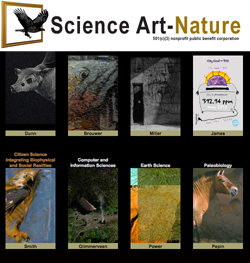
Science Art Nature exhibit at Stanford

The animated CO2 Toaster widget is one of 38 artworks selected for exhibit as examples of Science Art. The widget was designed to be an engaging and memorable tool to track CO2. It is a creative collaboration by artist/author Franke James, designer/programmer Bill James, and Michael McGee, creator of CO2Now.org.

The CO2 Toaster always shows the latest monthly data by pulling NOAA data for atmospheric CO2 from the Mauna Loa Observatory in the United States. The code can easily be added to most websites or blogs.

Why is tracking CO2 important?
Bill McKibben, founder of 350.org and author of Eaarth, has noted: “350 is a very tough number. We’re already well past it. The atmosphere holds 390 ppm today, which is why the Arctic is melting and the ocean steadily acidifying. To get back to a safe level we need a very rapid halt to the use of coal, gas and oil so that forests and oceans can absorb some of that carbon.”

The story behind the CO2 toaster

Franke James says, “We developed the CO2 toaster as our personal climate action for 350.org’s Day of Climate Action. We thought it was the best way to deliver this simple message on a daily basis: Don’t wait until we’re toast! Cut your CO2 Now! Since that event in October 2009, thousands of toasters have been downloaded for free. The opportunity to spread the message further through the Science Art-Nature exhibit was perfect. The toaster shows that artistic metaphors and concrete data can mix to produce lively offspring. Right brain people and left brain people can work together and produce some amazing results.”

Michael McGee comments, “CO2 prefers to keep quiet and out of sight. The CO2 Toaster widget yanks away the invisibility cloak and reveals the CO2 trend for the culprit that it is. This widget grabs attention and shares important information about our planet. Not only does it say what CO2 is right now, it shows what CO2 has been, and what it should be.”

The Science Art-Nature Exhibit

The 38 images included in the 25-topic exhibit will remain online as part of Science Art-Nature’s mission to raise the prominence of Science Art and the benefits of combining the accuracy of science with the evocative power of art. The exhibit helps to communicate the benefits of Science Art by informing viewers about nature and encouraging the sustainable use of resources.

What is Science Art?

“Works of Science Art skillfully represent truths about the world and its creatures, often suggesting important connections among subjects and their surroundings and teaching us indirectly about nature itself.” Science Art-Nature

Science Art Categories: The 35 categories included Atmospheric and Oceanographic Sciences, Organismal Biology, Ecology, Anthropological Approaches to Environmental Change, Materials Science and Nanotechnology, Computer and Information Sciences Link, Education, Agriculture and Horticulture, Ecotoxicology and Environmental Protection.

Participating Artists: Bev Abbott, Chris Augusta, Carel P. Brest van Kempen, Martha Brouwer, Pery Burge, Kelly Dodge, Christophe Drochon, Lori Dunn, Ulco Glimmerveen, Franke James, Bill James, and Michael McGee, David N. Kitler, Martin Lasack, Liz Lee, Terry Miller, Robert Mullen, Rick Pas, Patricia Pepin, Teri Power, Jennifer Rodriguez, Edward Rooks, Judith Gebhard Smith, Jim Turanchik, Darryl Wheye, Ria Winters, Floy Zittin.

About Science Art-Nature

Science Art-Nature is a nonprofit organization founded by Stanford University scientists, Don Kennedy and Paul Ehrlich, artists Tony Angell and Darryl Wheye, and nonprofit consultant Pamela Meadowcroft. It has launched an online Science Art exhibit with the generous support of Artists for Conservation (AFC) Center for Conservation Biology, Stanford University (CCB) National Audubon Society Stanford Institute for Creativity and the Arts (SiCa) and an anonymous donor. The exhibit features artwork relevant to the research presented at the AAAS Pacific Division meeting, “The Art of Science,” Ashland, Oregon, 13-17 June, 2010.

Exhibit link

Green Living Magazine writes: “There’s something about Franke”

“Franke James is using her creativity to tackle climate change—armed with a paintbrush and a vivid imagination—and having dazzling results.”
Photo of Franke James by Kourosh Keshiri for Green Living Magazine

Franke James, artist, author and co-founder of The James Gang, is profiled in the Fall 2009 issue of Green Living Magazine. The issue urges Canadians “to take a stand” and challenges them to become greener citizens.

“Canadians want to do more for the environment than the proverbial ‘changing of lightbulbs,’ ” says Lindsay Borthwick, editor of Green Living magazine. “The goal of this issue was to show them how. From voting to volunteering, leading by example to making climate change art, we’ve showcased the numerous ways to help individuals, families and communities work toward significant environmental change.” Green Living Magazine cover, Autumn 2009

Green Living journalist Astrid Van Den Broek interviewed Franke for the profile and wrote, “James’ voice comes through so strongly in her eclectic, captivating online visual essays that sometimes I feel like I’ve been reading her diary entries, instead of public documents. But that’s exactly why they stand out. While so much environmental messaging is filled with admirable but often abstract concepts or clichéd language that fails to connect with its audience, James manages to avoid both. Instead, she offers her atypical journey toward a greener life in these can’t-click-away illustration-meets-photography-meets-storytelling essays.”

The Social Leper illustration by Franke James

Franke comments, “I was delighted when Green Living said they wanted to do an article on my environmental visual essays. However I was totally amazed at Astrid’s thoroughness in interviewing me — even interviewing people I know from across the country. And going back to where I attended grade school! I joked that it reminded me of the Sesame Street segment “This is YOUR Life!” I’m not usually the one being interviewed (if you know my work, I often interview friends, family, pundits, and strangers for my essays). But I’m very grateful they decided to write the article, and honored to be part of their “Take a Stand” issue — because taking action on climate change is the #1 challenge we face. Failure to reduce CO2 emissions today imperils the future well-being of our children and future generations. Society as a whole has not gotten that message, yet.”

Alex Mayer, Director of the Michigan Tech Center for Water and Society, who helped Franke calculate the stormwater runoff for Paradise Unpaved, was interviewed for the article. Dr. Mayer comments, “I’d never seen anything like these essays applied to environmental advocacy and it affected me intellectually and emotionally.”

Astrid goes on to write, “Mayer’s experience is echoed by Stan Kozak, curriculum specialist for Learning for a Sustainable Future, who recently witnessed James’ tour de force at a workshop on climate change education. “We’d spent two days looking at the science and it was not looking good. Then, bango, Franke James comes along and says ‘do the hardest thing first’ and then shows that she has done it and is still living to prove it—and she is artistically thriving and maybe even seeing some financial benefits as well,” says Kozak. “I think Franke should be the ‘closer’ at more conferences just to keep people’s spirits up—and let them know there is hope if people take personal responsibility.

“There’s something about Franke” is a lively and entertaining read about Franke’s role as an artist, environmental author and activist. It shares her passion, creativity and counter-intuitive advice to ‘do the hardest thing first’ with a growing audience.

But the story is still being written as Franke continues to share her message of environmental art and activism. Ryan Dean, a 350.org coordinator at Bates College (and a recent graduate) commented on her Bates College keynote to this year’s incoming students:

“What can I say? Attending your talk really put things into perspective for me. I can honestly say that your visit to Bates really made all of the lofty possibilities a tangible reality. I am so impressed because you not only recognize that you must take up this social responsibility yourself, but you are actually compelling enough to get others to do the same. Students here came away from your talk both with a greener conscience AND ways in which they could create activist art themselves. It’s brilliant.

I find your combination of activism and art completely inspiring and it has sparked an energy in me that has only grown in the days since! My head is buzzing with the number of new ideas that I am determined to see come to fruition. Thanks for everything.”