1. DOES YOUR CITY HAVE A PLAN? Use Google to find out if your region has a Mitigation and Adaptation Plan for climate change, like Toronto and New York have. (And if they don’t, then press your local politicians to develop one!)
2. MAKE YOUR OWN PLAN. Develop your own personal Mitigation and Adaptation Plan. There are many actions each of us can take to protect ourselves and our property from floods, heat waves, power shortages, water shortages… etc. See the Resources below for ideas such as this one from the Institute for Catastrophic Loss Reduction: Handbook for Reducing Basement Flooding.
3. TAP INTO ENVIRONMENTAL NETWORKS: Get the ball rolling by participating in environmental action, or financially supporting, these environmental organizations and others:
GET A LITTLE HELP FROM YOUR FRIENDS:
– Take action in your community to build the future you want (not the one you fear).
– Connect with like-minded people. (Twitter can help to connect you.)
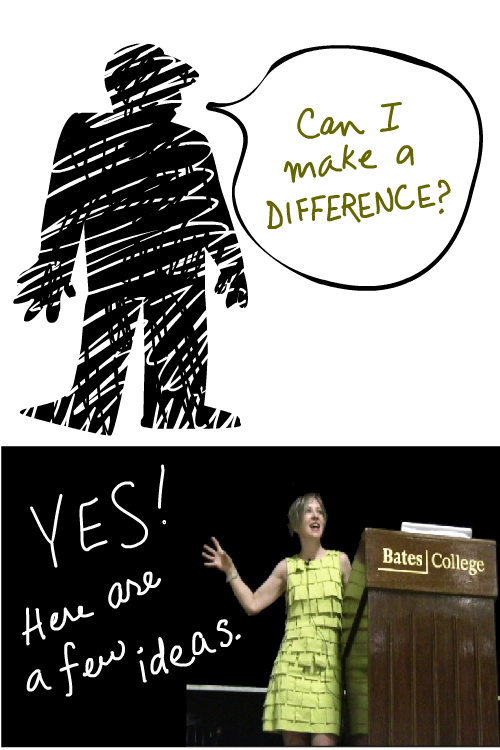
Artist and author Franke James speaks at Bates College Sept 5, 2009
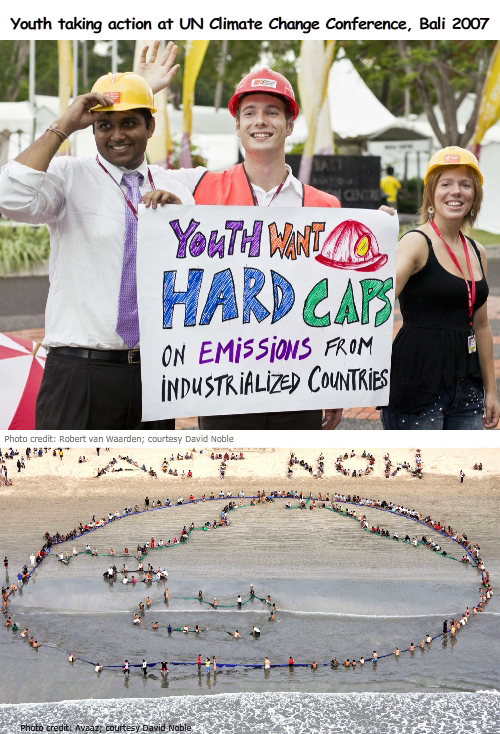
So, thinking that one of the best ways to inspire the Bates students is to show other students making a difference… I started by showing photographs from the 2007 United Nations Climate Change Conference in Bali. The first photo shows students asking for hard caps on emissions. They did a great job of finding a symbol (hard hats) to tell their story, visually. (My thanks to environmental activist and speaker David Noble for the Bali photos.)
The “Act Now” photo shows people creating an image of the world, with half of it submerged in water due to rising sea levels from climate change.
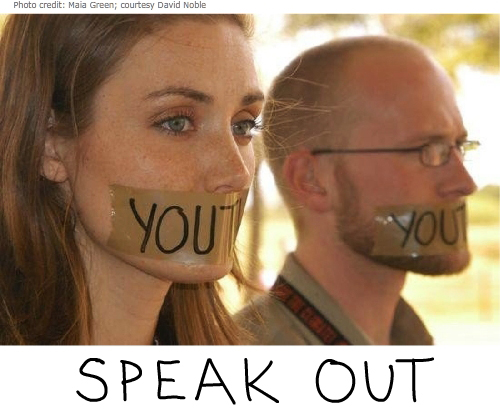
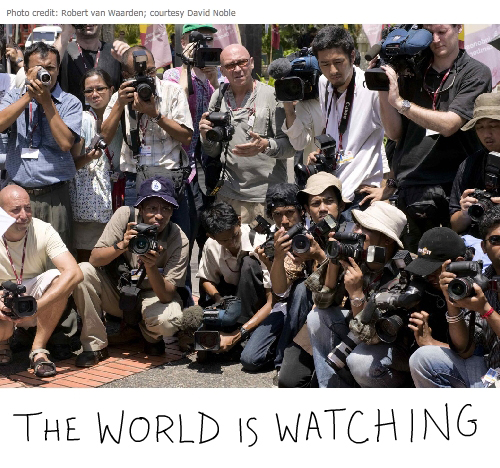
Students at the 2007 conference were frustrated that they did not have a voice at the negotiating table. And they found a memorable way to communicate that message to the cameras.
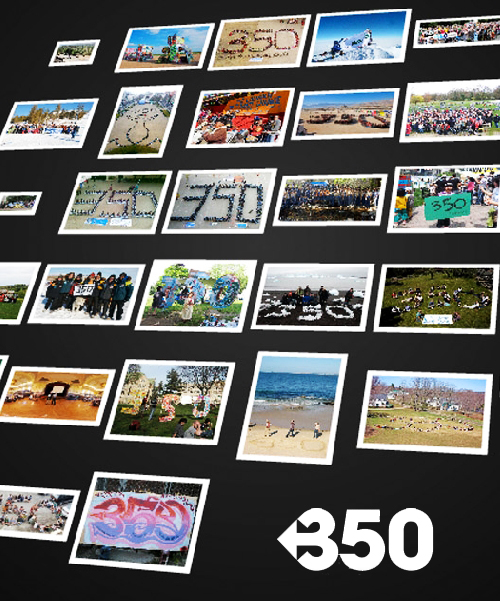
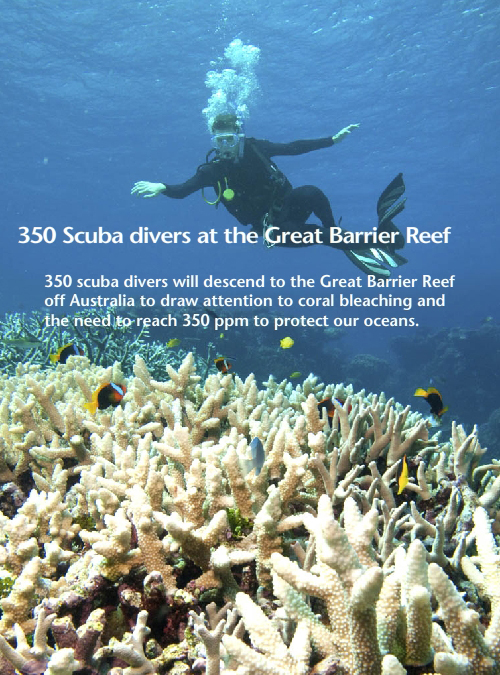
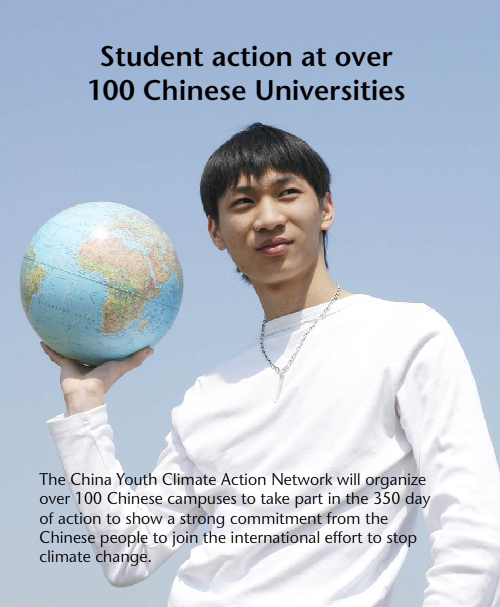
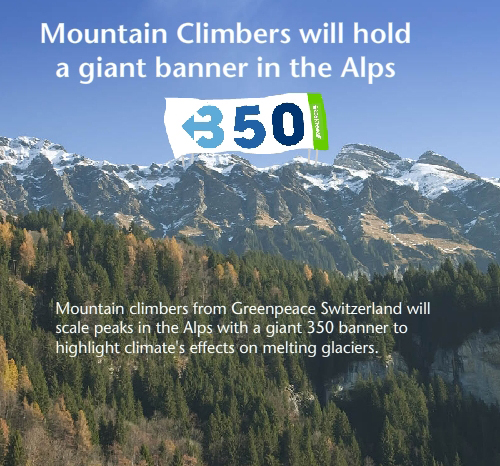
During my talk, I also pointed students to 350.org for ideas on what they can do and how they can organize an action for October 24th. The Great Barrier Reef, Chinese Universities, the Swiss Alps — these are just three of the many actions planned for October 24th, in over 100 countries.
Brainstorming 350 actions
So, do you remember at the beginning when I said I’d been inspired at the dinner the night before my talk? During dinner we brainstormed ideas for worldwide actions on October 24th, which included using performance art techniques.
Bates College French professor, Kirk Read told me about Frozen Grand Central, an improvisational acting piece that took place in New York City. It is a brilliant example of live street theater at one of the busiest stations in the world, Grand Central. Over two hundred people suddenly stopped — frozen — caught in the middle of various ordinary activities (picking up papers, eating a banana, looking at a map, kissing) as if in suspended animation. The on-lookers didn’t know what to make of it. Why were the people not moving? What was wrong? You can watch the YouTube video below to see their stunned reactions. After 5 minutes, all 200 actors snapped out of it, as though nothing had happened.
So how does this relate to climate change?
Getting the world’s attention on climate change is tough. You need a strong hook. Frozen Grand Central offers that hook in a fun, easy way. I can see the opportunity to use this dramatic “Frozen” act for a Flash mob 350 demonstration on October 24th. And so I wove it into my talk at Bates the next day… Now I don’t know if anyone will use the idea — but if you do — please let me know!
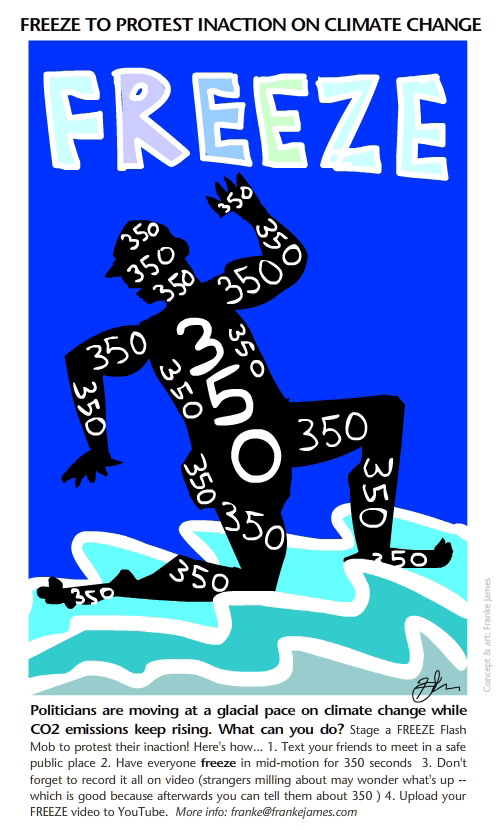
Freeze to Protest Inaction on Climate Change
Stage a Freeze Flash Mob: Gather a team of 350 people. Have all of them wear t-shirts, buttons, or hand-made labels, with the 350 message. Gather in a busy (and safe) public area. Take video as your team freezes for 350 seconds (about 5 minutes). Watch the stunned reactions of passersby… When they snap out of it explain the meaning of it: To protest the glacial pace of action on climate change. Of course, don’t forget to upload the video to YouTube and send it to the news media, with a press release.
Curious what Bates is doing for October 24th?
Bates Buzz on 350
Bates is buzzing with activity… The 350.org group (which includes on campus and local people) has multiple arts and sports projects planned for October 24th. While I was on campus, I met with Julie Rosenbach, Environmental Coordinator at Bates and Emily Grady, a Senior student. Emily is developing an environmental leadership program and is involved in organizing 350 students to cycle in support of 350.org.
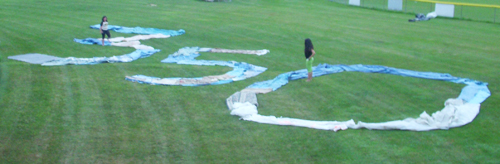
Ryan Dean, a 2009 Bates graduate working with the 350.org group, shared with me his Bird’s Eye View project. Ryan is hoping the idea will spread internationally, from rooftop to rooftop.
“The Bird’s Eye View is a network of recycled art installations, constructed on rooftops, in collaboration and support of 350, an international grass-roots organization for the reduction of carbon emissions. Images of the installations will be taken to be spread by use of the media to the general public, raising awareness about global warming. The images send a message of green peace, global solidarity, and a broadened human perspective.” Ryan E. Dean
I think of the Bird’s Eye project like horizontal billboards on rooftops — but shouting their message to air traffic, satellites flying overhead — and of course, the all-seeing eye, the news media. With Google Maps, and a little Photoshop artistry, we can imagine what Ryan has in mind…
Co-operators Becomes 1st Insurance Company to Join Ceres
“The insurance sector, the largest industry in the world, has been hit hard by climate change impacts, and is a critical part of the climate change solution,” said Ceres president Mindy Lubber.


 350
350


 Franke James merges science, art and storytelling to inspire people to take action and “do the hardest thing first” for the planet. Franke uses her skills as an artist, photographer and writer to create visual essays on environmental and social issues. She is the author of two award-winning books, Bothered By My Green Conscience and Dear Office-Politics, the game everyone plays.

 Artist and author Franke James speaks at Bates College Sept 5, 2009